“Why Reacting to Others Leaves You Exhausted”
One lazy holiday, as I absentmindedly watched a soccer commentary video, a certain phrase caught my ear and completely struck a chord with me.
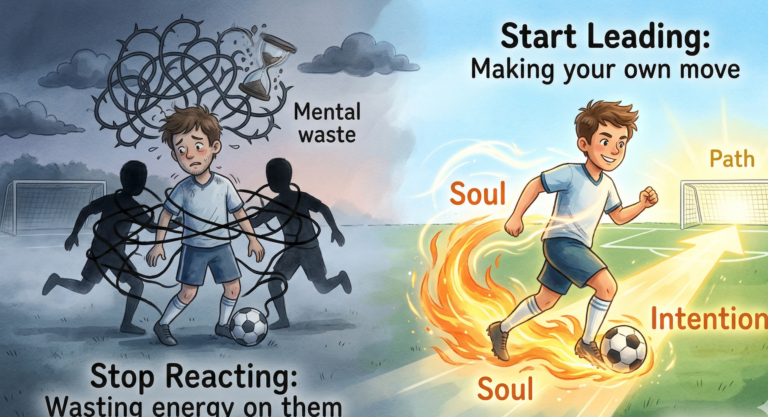
According to the video, when a player is dribbling and constantly reacting to the defender—thinking, “If they move like this, I’ll do that”—they not only add unnecessary movements to their play but also waste precious mental bandwidth, leading to severe exhaustion.
What you truly need is to take the initiative. You must have a clear intention of your own—”How will I get past them?” “Where do I want to pass?”—and assess the situation based on that goal.
I felt that these words were a profound truth that pierces right to the heart of not just the green pitch, but our everyday work and human relationships as well.
For example, think about when you ask a colleague for a favor at work. Do you ever find yourself overthinking their situation or reading their mood (i.e., their “movements”), worrying, “Are they too busy right now?” or “Will this request be a burden?”
Even before speaking to them, you repeatedly run simulations in your head, exhausting yourself before you’ve even taken any action. And as a result of walking on eggshells, your actual request becomes so sugarcoated and vague that it rarely leads to a good outcome… I can personally relate to this more times than I’d like to admit.
This is the exact state of “exhausting yourself by trying to match the other person’s movements.”
Being considerate and caring about others is, of course, a wonderful trait. However, if you worry so much about how others will react that you lose sight of what you truly want to do, you’ll never be able to move the “ball”—your project—forward.
The key is to first clarify what you want to do.
Try bringing your thoroughly considered goal straight to the other person. Even if it seems like a tough request to them, if there is a clear, undeniable intention of “This is exactly how I want to do it,” your passion will breathe a fiery “soul” into the work. As a result, both sides will be able to do great work together.
Only when you make a straight pass with your own intentions will the other person return a genuine pass of their own. From there, you can begin the dialogue to align your perspectives.
Keeping that gentle consideration for others, I want to first clarify what I want to do and communicate it straightforwardly. Then, using those expressed intentions as a starting point, I will listen to the other person’s opinions to find the best possible path forward together.
From now on, I want to keep this kind of proactive approach to work and communication in mind.
相手の動きに合わせると疲れる
「相手の動きに合わせるから、疲れるんだ」
休日の何気ない時間、ぼんやりと眺めていたサッカーの解説動画から聞こえてきたその言葉に、私は思わずハッとさせられました。
動画の解説によれば、ドリブルをする際、ディフェンダーの動きばかりを見て「相手がこう動くから、自分はこうしよう」と後手に回っていると、プレーに無駄な動きが増えるだけでなく、脳の思考リソースまでも浪費してしまい、ひどく疲労するのだそうです。
本当に必要なのは、自分が主導権を握ること。「相手をどう抜くか」「どこにパスを通すか」という自分自身の明確な意思を持ち、その目的のために状況を判断して動くべきだ、と。
この言葉は、緑のピッチの上だけでなく、私たちの仕事や日常の人間関係にも深く突き刺さる真理だと感じました。
たとえば、職場で誰かに仕事をお願いするとき。 「今、忙しいタイミングかな」「こんな頼み事をしたら負担だろうか」と、相手の状況や顔色(=動き)を先読みしすぎてしまうことはありませんか?
相手に声をかける前から頭の中でアレコレとシミュレーションを繰り返し、何も行動していないのに勝手に疲弊してしまう。そして、気を遣いすぎた結果、肝心の依頼内容がオブラートに包まれすぎて中途半端になり、結局良い結果に結びつかない……。私自身、思い当たる節が何度もあります。
これもまさに、「相手の動きに合わせようとして疲弊している」状態です。
相手を思いやる心や気遣いは、もちろん素晴らしいことです。しかし、相手の顔色を窺うあまり「自分が本当はどうしたいのか」という芯を見失ってしまっては、プロジェクトというボールを前へ運ぶことはできません。
大切なのは、まず「自分がどうしたいのか」を明確にすること。
自分が考え抜いた目的を、まずはストレートに相手へぶつけてみる。たとえそれが少し厳しい要求に映ったとしても、そこに「どうしてもこうしたい」という明確な意思があれば、その仕事には必ず熱い「魂」が宿ります。結果として、互いに良い仕事ができるはずです。
自分の意思というまっすぐなパスを出して初めて、相手も本音のパスを返してくれます。そこからお互いの意見をすり合わせる対話を始めればいいのです。
相手を気遣う優しさはそのままに、まずは「自分がどうしたいのか」を明確にして、まっすぐに伝えてみる。そして、ぶつかった想いを起点にして、相手の意見を聞きながら共に最善の道を探っていく。
これからは、そんな主体的な働き方とコミュニケーションを意識していきたいと思います。


コメント